New year writing competition: The winning stories – joint runner-up 2

Why I chose this story: It’s really well-paced – a bit breathless, which is so in keeping with the narrator’s emotions. I love this phrase: ‘the roots wefting and warping across the forest floor.’

When will you be done?

by Louise Witts

She’d struggled to find it. The late summer light was fading and the woods more overgrown than ever. She could hear her husband’s voice telling her to be careful… laughing that new hips were expensive. That made her smile. He’d had his hips and knees done. Bionic, according to him. She shined a torch onto the roots wefting and warping across the forest floor. One step at a time, she reassured him. It would be 10 years this September. Sudden. Was that better? Better for him, maybe. But for her? Who knows? You think losing somebody another way may be easier but you’ve still lost them. You can’t turn back time. That made her laugh. Because that’s exactly what she was trying to do. Turn the clock back 50 years to when she’d last sat under this tree. This gnarled, ancient tree that was no more or less remarkable than the others, except it was where they’d sat. Not her husband, she’d met him later. No, this tree was where she and her neighbour… her best friend… had played and hid and laughed and, finally, kissed. He was her first kiss and recently she’d remembered something. A laughing, silly, off-hand remark he’d made the last time they were here, the night before she left for university: “Meet me here in 50 years,” he’d said. “Meet me and I’ll bring Champagne, you bring strawberries.” He’d suggested Champagne because it was the poshest drink they knew and both agreed going to university was very posh. She was happy but scared everything would change. Of course, she was right. That was the last time they saw each other. His parents moved. Her parents moved. This was before mobiles and emails and messenger, whatever that was… so when you lost touch, that was it. Lost. She hoped he’d lived a happy life. Hers had been.. was… happy. She had her children and grandchildren. But, recently, she’d started to dream about the woods, about this tree. All she could think of was that silly, off-hand remark. So that day, on impulse, she’d jumped on the train and made the two-hour journey ‘home’. A taxi dropped her on the edge of the woods. Ring me, the driver had said. Ring when you’re done. But when would she be done? As the last rays of sun disappeared and the temperature fell, she started to think that maybe it was time to go. Especially when her torch gave up. It was her grand-daughter she heard now: use the one on your phone, Grandma. Good idea, my love. She began to dig around in her bag but, as she did, she realised she was not alone. A light headed towards her. She barely dared breathe. Then a voice she knew well cut through the darkness and 50 years: “I hope that’s strawberries in your bag otherwise I’m not sharing this!” She laughed. And she knew very well that she wasn’t done yet. Oh no, she wasn’t done yet.

Louise Witts is a freelance writer, living in London and Devon (where she grew up). She enjoys reading and writing all forms of fiction, including short stories, and has a couple of novels on the go.
New year writing competition: The winning stories – joint runner-up 1

Why I chose this story: It has a quirky truthfulness, and a poignancy too. I love this line from Poppy, the woman from the launderette: ‘You have a lovely thread count on your bedding if you don’t mind me saying.’

Dead knots are a fault and weaken the wood. Rot seeps in. Some people prefer it.

by David Abbott

Ricky prefers it. He loves rot. He loves mould and fungi and decay. Ricky goes to the local cemetery in his lunch break to be closer to decomposition. He orders boxes of worms on-line to keep in his food waste bin. He watches things come apart.

As a child, Ricky collected any and all the dead animals he could find in the park or by the side of the road on his way home from school. Nobody ever troubled him about it because Ricky’s Dad had once appeared on World’s Strongest Man and had a reputation.

At Christmas, when other children gave the lollypop lady small bars of chocolate, Ricky would pop the perfectly preserved skull of a rodent or a bird in her pocket. He was annoyed that she never seemed to mention it.

One particularly lovely, spring day and Ricky is enjoying a cheese bap whilst leaning into the headstone of Wilma Lynch who had died peacefully at the age of seventy-two. It’s a pleasing plot as he has full sight of the wire bin that folks use to dispense of their flower detritus. Next thing and taken quite by surprise, a voice.

‘Did you know, Wilma?’

Ricky spins around and sees the woman from the launderette. He thinks her name is Poppy.

‘Oh. Oh no. I just, em…’

‘She was my mother,’ Poppy says. ‘There’s not a day goes by when I don’t think how lovely my life is without her.’

Ricky had only prepared a condolence type of response and now feels a bit befuddled.

‘Can I join you?’ Poppy sits down on the grass mid-question, so Ricky wonders why she asked.

‘Seen you at the launderette,’ says Poppy as she reaches into her bag for a watermelon and an alarmingly long knife. ‘You have a lovely thread count on your bedding if you don’t mind me saying.’

As untroubled by love and romance as Ricky has been for all of his life, he feels certain that this is a moment to practice what they teach him at LIFE SKILLS CLASSES. It’s in capital letters in his head because the things he does most days are usually in capital letters. And laminated. And on a wall.

‘My favourite duvet cover has all kinds of insects on it as a pattern. Mostly spiders and beetles.’

‘Why do you sit here at lunchtime?’ Poppy asks as she sets about her melon with gusto and enviable knife skills.

Ricky pauses. He tries to think if this is a ‘no-filter’ or a ‘try and be like other people’ moment. Unsure but emboldened he looks at her quite directly.

‘I like to be with things that are breaking apart but beautiful all at the same time. There’s something so much more truthful about it.’

Poppy hands him a slice of melon and Ricky notices that though her face is wet with tears, she is smiling as well.

‘I think it’s on the turn,’ she says. ‘Just how you like it.’

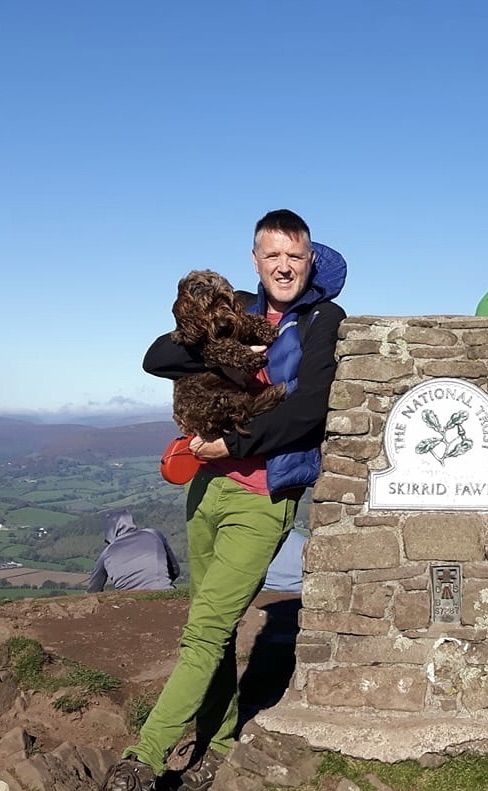
David Abbott lives up a hill in Wales with a husband and a rescue dog, and is an occasional writer of fiction.

Writing competition – Final results

Winner

David Abbott, for The Next Good Joy That Mary Had

Runner-up

Dudley Martin, for Spoor

Also shortlisted

Catherine Edmunds, for Winter Needs Watching

Darren Gillen, for Spider, Spider

Carolyn Stockdale, for Chapter 39

Special mention

Samuel Dodson, for The taste of champagne

Lucy Kaur, for The Illustrator

Sarah McPherson, for Ice Age

The runner-up’s story will be published on Saturday, 18th February,

The winner’s story will be published on Sunday, 19th February.

MANY CONGRATULATIONS ALL!