Guest post: Lindsay Bamfield on Australian Literature

This year there was a book by a Tasmanian author on the Not the Booker Prize shortlist. I thought it was about time I found out a bit more about Australian fiction writing, and invited the author Lindsay Bamfield to write a guest post for me.

Lindsay relocated from London to Melbourne six months ago. She writes short stories and flash fiction and has two stalled novels needing attention.

Here are Lindsay’s recommendations. Do add your own in comments.

Mining for Australian Literature

Lindsay Bamfield

Moving in to my new home in Australia, I set up a couple of Australian literature shelves in my bookcases. To accompany my battered copy of A Gold Digger’s Diaries by Ned Peters (my great-great-great-great-uncle!) were novels by writers I’ve read before, including Tim Winton, Jane Harper and Kate Grenville. Following Ned’s example of gold mining I mined for new literature. I browsed bookshops and, most importantly, joined my local library and found books encompassing Australia’s many cultures from a number of Australian authors writing a huge variety of characters and settings in an equally wide range of literary styles and genre.

I’ve read hard-hitting short stories by Tony Birch (Common People and The Promise), found the fictionalized story of Louisa Collins, The Killing of Louisa by Janet Lee fascinating and, to be honest, read several others that I didn’t rate very highly. The following, all from writers I hadn’t come across before, stood out for me as good reads.

Peter Polites’ The Pillars is a contemporary urban story of a gay man of Greek heritage. Vibrant, urgent and often dark, it is a story of the outsider. Covering racism, homophobia, greed and the ever-changing face of cities, it focuses on fitting in as the pillars of society crumble for new ones to emerge.

In contrast, Milk Fever by Lisa Reece-Lane is set in a small country town named Lovely. For newcomer Julia it’s anything but lovely. Overshadowed by her controlling husband she is drawn to Tom, a young farmer who experiences life and the surrounding countryside through nature’s colours and vibrations. I loved this gentle story of people at odds with their family members but ultimately at one with their environment.

Kate Richard’s Fusion is set in the remote wilderness where conjoined twins Sea and Serene live in self-imposed seclusion with their cousin, Wren. Self-educated, their life is richer than their circumstances might suggest. When Wren finds an injured woman on a lonely road, he brings her home to tend to her injuries and all three find their relationships are tested. An unusual and lyrical read.

Shepherd by Catherine Jinks, perhaps better known for her children’s and middle-grade literature, is the story of a young convict transported to Australia for poaching. Working as a shepherd for a settler he becomes the target for another convict, a vicious murderer. Can he outwit his pursuer? I found this fast-paced story fascinating.

Extinctions by Josephine Wilson tells of widowed Frederick Lothian, a retired engineer coming to terms with his future in the detention centre for the elderly as he calls his retirement village in Western Australia. Touching on the big issues of identity and the Stolen Generation, Fred meets Jan a fellow member of the retirement village whose blunt approach makes him confront his mistakes from the past and how they have affected his son and adopted daughter. Often witty and sometimes light it is also a serious thought-provoking read that I was sorry to have to return to the library.

Lindsay Bamfield
Photo copyright Lindsay Bamfield

Coming next: Friday story and preview of Candyfloss III

More thoughts about literary prizes: The Booker

So, this was a surprise – joint winners of The Booker Prizer 2019. The organisers might have been shocked, but I think a lot of people have welcomed the decision of the judges to flout the rules and award the prize jointly to Margaret Atwood for The Testaments and Bernadine Evaristo for Girl, Woman, Other. Seeing the way the two authors have responded to the decision is no less than inspiring: visibly supporting one another, plus Margaret Atwood is gifting her share of the prize money (£25,000) to the Canadian Indigenous charity, Indspire, which invests in the education of Indigenous people. 

I’m rather shocked that the Booker organisers are apparently so angry about the judges’ decision that they are threatening to withhold their fees. That seems very small-minded.

Who could not be pleased to see the warmth between Atwood and Evaristo? I’m looking forward to reading both their books.

Booker prize winners 2019


Coming soon: The return of the Friday story


Festival time

Festival time is a-coming. Not for me – at least not yet! – the heady heights of Hay, but I will be speaking at two writing festivals in April.


Abergavenny Writing Festival, Thursday, April 11th, 2.30pm

Do we all have a novel in us?

I’ll be on a panel with fellow authors Jack Strange, CG Menon and Penny Ellis. We’ll be in discussion with Abergavenny Focus Magazine editor Hannah Hill.

Aber Writing Fest

You can buy tickets here


Llandeilo Lit Fest, Saturday, April 27th, 2.15pm

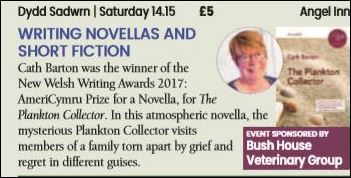
Writing Novellas and Short Fiction

I’m excited to have my very own event at Llandeilo, where I’ll be in conversation with fellow writer Jane Fraser, whose debut collection of short stories, The South Westerlies, will be published by Salt in June.

Llandeilo Litfest

Buy tickets for that event here


And if you come to either, do be sure to come and say hello!


Guest post: by author Nadya A.R.

In the first of a series of occasional guest posts, I welcome author Nadya A.R., to tell us about her novel Invisible Ties, and in particular why labels fail to do justice to the complex reality of women in the sub-continent.

WHY I HAVE A PROBLEM WITH LABELS!!!

Nadya A.R.

I am a writer, psychotherapist and motivational speaker. My latest novel, Invisible Ties, has been published by Rupa publications in August 2017. In Invisible Ties my protagonist, a well-educated woman in her early twenties, Noor Kamal, faces the overbearing pressure of marriage and succumbs to an arranged proposal, engineered by her shrewd, worldly wise Aunty Lily, who lives in Malaysia. An eligible, Pakistani banker, Meekaal Kalim, living in Singapore views her picture in her Aunt’s plush home in Kuala Lumpur and expresses his interest in marrying her. Noor’s intelligent father scoffs at this seemingly bizarre proposal, while her materialistic and socially competitive mother feels as if she has won a huge lottery.

Noor is definitely not the stereotypical, oppressed Eastern woman. Neither can she be described as a kickass nor as a badass heroine- terms which are now the flavour of today. Her reality is complex and evolving, very similar to what is happening in South Asia and to women in our modern world. Noor’s circumstances of agreeing to this marriage are unique and drastic, and though she perceives herself as ‘different’, she finds herself cast in the same mould as many women around her.

While grappling with the disturbing fact that her husband is a cold stranger in a foreign land, Noor is well-aware that she was given a one-way ticket by her parents. She is expected to make her marriage work regardless of the circumstances, which is the message that many parents give to their daughters, even in this day and age. However, there is that spark in Noor, regardless of the stifling pressures of an out-dated society, which lies dormant within her. Enjoying the new sights and ways of Singapore, and by opening herself to the narratives of others around her, Noor starts questioning and then challenging the norms which undermine her individuality and most important, her happiness.

Like many South Asian women living in the West, and those surviving and strong in their native, nurturing environment, Noor learns how to balance and juggle the traditions and values, which are perhaps more than a part of her and define her sense of self. Though she holds them and the wishes of her parents in high regard, her identity is no longer determined by the significant others and people around her.

The most important aspect of her journey is how she ventures out of her comfort zone, in her case the close and compact, South Asian community, and seeks out people who don’t identify with her philosophy on love and life. In the process, she is overwhelmed and utterly confused between the right and wrong, which again is dispersed in shades of grey around her. Until, she learns to live with the discomfort and those emotional ties, which now have a different meaning in her life. Her evolution reflects the change that we experience to become stronger, and as we stumble, fall and then rise as women to take charge of our lives.

UK readers can buy Nadya’s novel Invisible Ties here.

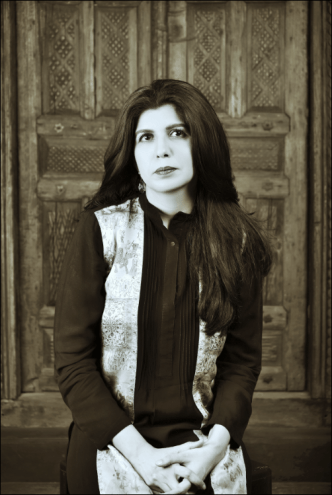
Nadya A R

Author Nadya A.R.

Reflections on writing (No 1 in an occasional series)

Like all writers, I read as much as I can. I do this primarily for enjoyment rather than as an academic exercise, but of course it informs my own writing.

As I embark on a year’s mentoring I’m learning more about so-called ‘rules’ of writing, or at least recommendations. One of these is that dialogue is good. It breaks up the text, makes it easier to read. I’m a (fairly) diligent student and I’m currently sowing dialogue through the short stories I’m writing.

Another recommendation is to use the active voice. Passivity distances the reader. Yes, I’ve bought into that one.

Don’t jump from one point of view to another. Very confusing for the reader. Okay, must bear that in mind.

I am greatly encouraged when I read other people’s work which breaks these ‘rules’. I’ve just devoured Jon McGregor’s Reservoir 13 (2017). I have followed Jon McGregor’s work since his first novel, If Nobody Speaks of Remarkable Things (2002). This book became a success by word of mouth. Since then McGregor has gone on to become ‘a prize-winning author’. I put that phrase in inverted commas because, affirming as that may be, it’s just one thing about him, not for me a defining characteristic.

After I’d finished the book I looked up some one-star reviews, curious to know why anyone would not love this book as much as I did. Criticisms include it being boring, that nothing happens, difficulty of keeping track of multiple characters and, interestingly, lack of dialogue and the use of the passive voice. I think the problem is that people have certain expectations of a book, instead of reading it on its own terms. A cursory glance at the blurb on the back will tell you that this is not a conventional murder mystery story.

The comment that ‘Anyone could write a book like this’ is, frankly, crass. If one day I can write something that is halfway as compelling as Reservoir 13 I will be a very happy person. I’ll never write in the same way as Jon McGregor and neither do I want to do so. I want to use my own voice, and while I will think about writing ‘rules’, I will also feel free to break them.