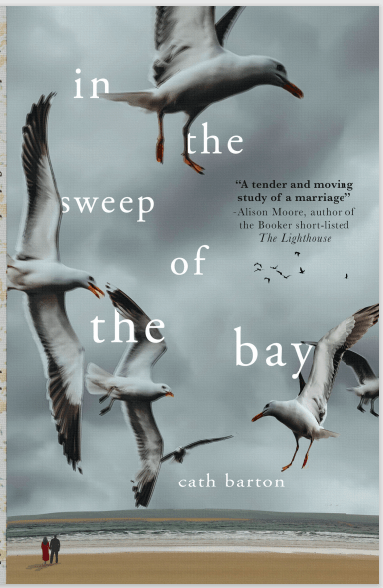
Just two weeks to publication day for my second novella, In the Sweep of the Bay. Published by Louise Walters Books on 23rd November, it’s the story of a long marriage, with all the attendant hopes, joys and sadnesses.
The main setting for my book Morecambe in Lancashire and I’ll be writing about the location when I guest on Isabel Costello’s Literary Sofa next month. Isabel has given my book this lovely endorsement:
“This poignant novella has the feel of Revolutionary Road in a northern town and the outsize power of Mothering Sunday.”
We have a whole month of blogs to come, starting with a guest spot with Amanda Huggins tomorrow, 9th November, where I talk about the changing roles and expectations of women over the course of the second half of the twentieth century, as portrayed in my book.
Louise Walters is hosting a launch party on Zoom at 6pm on Sunday 22nd November, the eve of publication day. Hannah Persaud, whose brilliant debut novel The Codes of Love was published earlier this year, will be interviewing me, and there will be (short!) speeches, a reading from the book and a Q&A. All welcome. Contact me or Louise if you’d like to join us.
Meanwhile, you can pre-order In the Sweep of the Bay direct from the publisher, from the new bookshop.org that supports indpendent bookshops, or from Amazon.
In the last of my current series of guest posts from authors with new books out, a big welcome to Drew Gummerson with his thoughts on that most crucial aspect of writing – the editing process.
Certain books, written quickly, are infamous; Jack Kerouac’s On The Road, dashed off while on the bog, written in a cramped hand along the length of a single roll of toilet paper(*), Charles Bukowski’s Post Office, 2 weeks in the making, squashed between Bukowski’s bar brawls and unsuccessful attempts at picking up Women(*), (his next book, 3 days later(*)).
(Sequestered once in hotel room Bukowski refused to appear on same bill as one and only Burroughs, William (now he was editor; cut text with scissors, scatter text across floor, shoot heroin, piece text back together. For many years Burroughs carried pages of Naked Lunch (deconstructed / constructed) gripped with single elastic-band in suitcase across Paris / Tangier / Interzone.(*))
But for most of us, as Morrissey sang, These Things Take Time.
(And I know that I’m the most inept that ever stepped…)
The best advice I ever got about editing came backwards through a crude joke on The Inbetweeners. This crude joke was about having a numb hand and masturbation.
It’s better all round if you no longer feel it’s yours. (**)
When I finished the first draft of Seven Nights at the Flamingo Hotel I put it away for six months.
It was only then I had the right perspective to be brutal, see what worked / what didn’t. So I could slash and burn. And, I honestly couldn’t remember where it was going.
It was fresh.
And that’s where the real work started.
In this excellent New York Times article, Jenny Offill talks of how she put extracts of her new novel Weather onto poster-boards and it was only, through time, by looking at them, she could ascertain which ones sparkled, which ones weren’t merely clever.
In that first draft it’s all too easy, like Alice falling down her well, to be pleased with yourself. Time gives clear head to tidy up (delete) these sections which don’t sparkle, aren’t clever (I mean, who wrote this shit?).
On twitter Ronan Hession (writer of the wonderful Leonard and the Hungry Paul(**)) gave the Sound Advice of, when editing, to read the chapters in reverse order. This,
“1. Stops you getting distracted by the story.
2. Reveals a lot about flow… if a book reads well backwards it’s a good indication that it reads well forwards.”
Same as putting text away in drawer it is about finding a different way of looking / disrupting gaze.
His editing process was to write reams and reams of stuff trying to find the character. It was only by writing in character’s voice that the nuggets of genius that made it into the story came out.
Seven Nights at the Flamingo Hotel was written on my iPhone, sitting at my kitchen table, most often before I went to work. Just an hour or two.
Having once been an obsessive writer I made a deal (with myself) a number of years ago that I would keep my evenings free for movies, music, books etc etc etc (wine).
In those few hours, like Offill I ended up with many dozens of pieces / fragments / sketches.
The trick was to work on them work on them work on them and, as Saunders suggests, find the heart of what you are trying to say.
(*) – This is not exactly true.
(**) – This is exactly true.
Drew Gummerson is the author of The Lodger and Me and Mickie James. His latest book, Seven Nights at the Flamingo Hotel, is to be published in November 2020 by Bearded Badger Publishing
It’s been such a pleasure to welcome other authors onto my blog over the past few months to share their thoughts on aspects of writing. Coming up we have the final post in the current series, from Drew Gummerson, on the topic of editing. So call back tomorrow for that.
Then I’ll be onto my own new novella, In the Sweep of the Bay, published on 23rd November by Louise Walters Books. News about the launch event coming very soon, but in the meantime you can pre-order here.
I pleased to welcome children’s author Emma Rea as my guest this month, with her thoughts on writing rules and breaking them, in particular that vexed issue of showing versus telling.
When I was at school, I had a wonderful English teacher (who herself was taught by CS Lewis) and she said several things that stayed with me. One of them was her explanation of the trellis and the rose.
She was teaching us Shakespearean sonnets, and she showed us the form: the three quatrains rhyming abab, cdcd, efef, followed by a couplet, rhyming gg. She explained the iambic pentameter. We all knew the rules.
Then she started telling us how Shakespeare broke the rules. Using half-rhymes, caesura, enjambement. We grew confused.
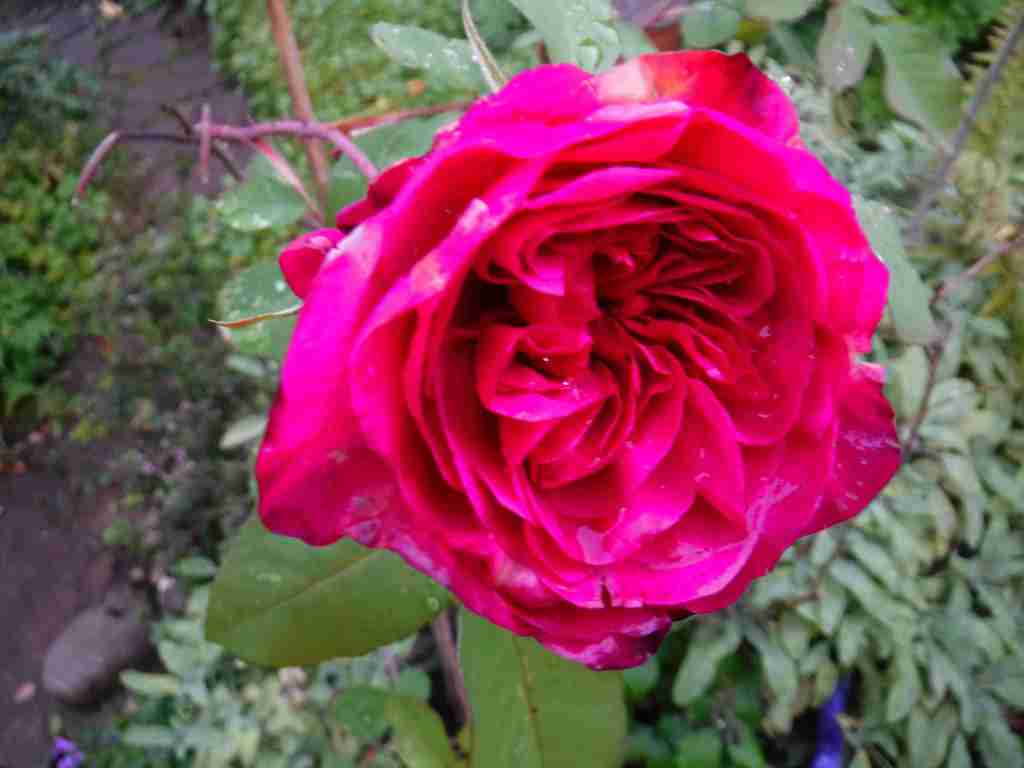
And she explained that in all writing, there is both form – the trellis to which the writing must cling – and the author’s insight and imagination – the rose. Without a trellis, the rose will flop. But if it follows the trellis rigidly, left, right, left, right, there will be no life in the writing at all.
I write children’s fiction, not sonnets, but her words still ring usefully in my head. I’m always trying to work out what form, or ‘rules’, work in writing and which rules can be bent.
And one rule I’m wary of is ‘show don’t tell’. We’re always told this, and of course it’s important, but a confident writer will know when to break it, and simply tell the reader certain things. This confidence is enormously appealing. Dickens’ first sentence of Bleak House is ‘London.’ A later paragraph starts ‘Fog everywhere.’ He goes on to show us, but he hasn’t been afraid of telling us, too. And we immediately get that delicious feeling that we’re in the safe hands of a writer who knows exactly what they’re doing.
I think this tension between telling and showing is pleasurable for the reader. They want to know some things – just as you want to know the rules before you start playing a board game – but they also want intrigue and nuance, so their curiosity is aroused and they can start trying to work things out for themselves. You have to have on the one hand, absolute clarity, and on the other, obfuscation, and the two hands have to be clasped, fingers intertwined, so that the text is both strongly rooted and yet open to interpretation.
Over ten years of writing and writing groups, I’m getting better at spotting in my own work which bits need clarity, or telling, and which don’t. I love checking out first chapters to see how authors find a balance between the two, and I like experimenting with telling to see what works.
I’ll leave you with an opening line which makes me feel grounded and safe, and yet curious. We’re given the location, the season and the time of day – and a springboard into the story.
‘It was an ordinary spring day in Istanbul, a long and leaden afternoon like so many others, when she discovered, with a hollowness in her stomach, that she was capable of killing someone.’ Elif Shafak, Three Daughters of Eve
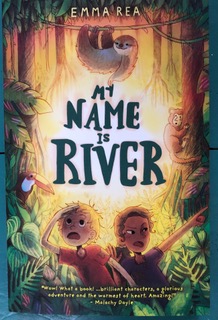
Emma Rea is an author, reviewer and proof reader. She is the author of MG novels Top Dog (Gomer 2014) which was shortlisted for the North Somerset Teachers’ Book Award and My Name is River, published this June by Firefly Press, and listed as Sunday Times Children’s Book of the Week in July.
Emma ReaMy Name is River is available online through Waterstones or Amazon, and can be ordered through any bookshop, or through the Firefly Press website.
A couple of days ago I realised that I had over 2,500 followers on Twitter and decided to do a giveaway of a copy of my forthcoming novella, In the Sweep of the Bay, due to be published on 23 November by Louise Walters Books.
I invited people to share something positive about the world – it’s so easy for us all to be grumpy these days!
So many lovely comments came in. Here are just a few of my favourites:
I read a piece of poetry yesterday. And then thought about it the rest of the day. Words still have the audacity and sheer exuberance to move us, in every time.
We can all still say ‘I love you ,’ send letters, walk on the beach, listen to music and most importantly … read a great book!
Adversity brings humour, sensitivity and creativity. The next generation are going to do wonderful things.
People also shared photos of people dear to them, of the beauty of the natural world and of animals – dogs, cats and a quokka.
It was a thread which brought me smiles, so thank you to everyone who contributed.
And the winner of the giveaway is….. Tilly – @TillyLovesBooks – who gave as her something positive:
The glorious autumn leaves – no matter what’s going on in the world, Mother Nature still manages to captivate.
If you didn’t win, you can buy an advance copy of the book from louisewaltersbooks.co.uk





 Cath Barton